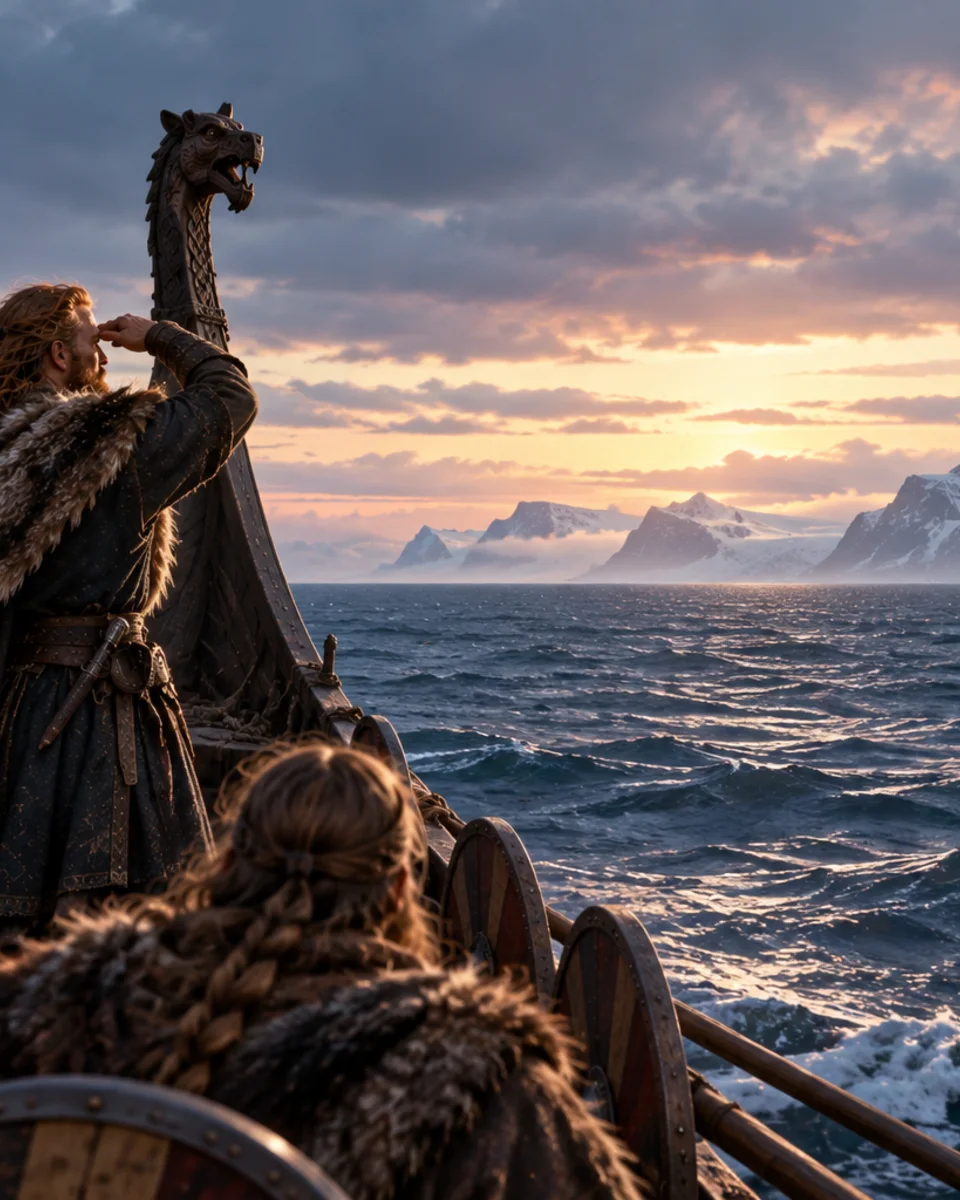
The wind howled across the dark sea.
Waves crashed against the sides of the longship, and salty spray lashed the men at the oars. Ahead of them lay nothing but mist, ocean and a grey horizon.
Behind them was Iceland.
Ahead lay the unknown.
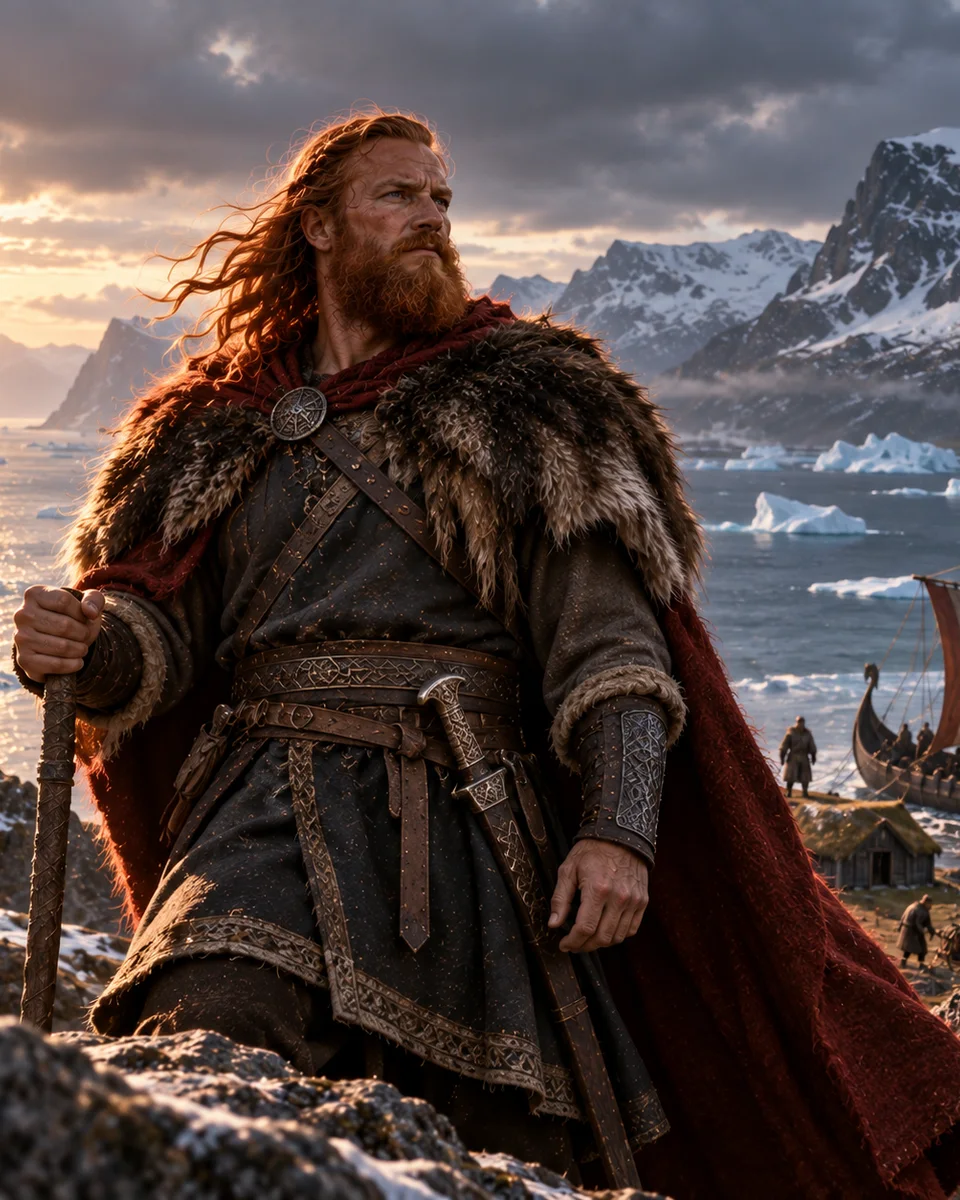
At the helm stood a red-haired man, staring westward.
His name was Erik the Red.
He did not know what waited beyond the horizon. Perhaps there was land. Perhaps there was only an endless sea.
But Erik could not turn back.
He was an outlaw.
And sometimes, it is only when every road behind us is closed that we discover an entirely new path forward.
The Red-Haired Viking
Erik was born in Norway around the year 950 and was named Erik Thorvaldsson.
From an early age, he learned how quickly life could change.
His father, Thorvald, was declared an outlaw after a killing and forced to leave Norway. The family loaded their possessions onto a ship and sailed west to Iceland.
There they began a new life.
But the son would prove to have inherited more than his father’s name.
Erik was proud, stubborn and quick-tempered. Conflicts with other men ended in violence and death, and eventually the same judgement was passed on him that had once been passed on his father.
Outlawed.
For three years, Erik was forbidden from remaining in Iceland.
For many, it would have been a disaster.
For Erik, it became the beginning of an adventure.
Tales of a Land in the West
Erik had heard old sailors speak of something strange.
A land far to the west.
Years earlier, a seafarer had been blown off course and had seen unknown shores beyond Iceland. No one knew much about the land. Perhaps the story was true. Perhaps it was simply another tale sailors told during long winter evenings.
Erik decided to find out.
He gathered a crew, prepared his ship and left Iceland behind.
Then he set his course west.
Out into the North Atlantic.
Across the Dark Sea
The days passed.
The ocean seemed endless.
The cold cut through their clothing, and the fog could grow so thick that the men could barely see their own hands. Icebergs drifted through the water like white mountains, and storms could raise waves higher than the ship’s mast.
Still, Erik continued westward.
Until one day, someone shouted from the ship:
“Land!”
Out of the mist rose enormous mountains.
Glaciers gleamed between the peaks, and deep fjords cut into the coastline.
Erik had found the land in the west.
He had reached Greenland.
Three Years at the Edge of the World
Erik was not content simply to go ashore.
Over the following years, he explored the coasts and fjords. He searched for places where people could live and animals could graze.
Along the southwestern coast, he found something that gave him hope.
In summer, the valleys turned green.
Grass grew beside the fjords. There were fish, birds and wild animals. It was a harsh land, but it was not a dead land.
People could live here.
Erik was already thinking about the future.
One man could explore a country.
But to build a society, he would need families, farmers, craftsmen and ships.
He had to return to Iceland.
And he had to convince others to follow him back.
The Name That Would Lure People West
When Erik’s period of exile was over, he sailed back to Iceland.
People gathered to hear his stories.
He told them about the fjords.
About the grazing land.
About the chance to build a new life far from old conflicts.
And he gave the country a name.
Greenland.
The green land.
According to the sagas, Erik chose the name carefully. He knew that people would be more willing to follow him if the land had an appealing name.
Erik the Red had not only discovered a new land.
Now he had to sell the dream of it.
And people listened.
The Fleet Sails West
Around the year 985 or 986, everything was ready.
Families said goodbye to relatives and friends. Animals were brought aboard. Tools, timber, food and everything needed to build a new community were loaded onto the ships.
According to the sagas, 25 ships left Iceland.
Ahead of them lay hundreds of kilometres of open sea.
But the North Atlantic was not going to let them pass without a fight.
The storms came.
Waves crashed over the rails.
The ships were separated in the darkness.
Some were forced to return to Iceland. Others disappeared.
Of the 25 ships, only 14 are said to have reached Greenland.
Those who survived had arrived.
Now the real work began.
A Home by the Fjord
Erik settled at a place called Brattahlid.
There, houses were built from stone, earth and turf. Animals were released onto the grazing land, and smoke began to rise from the hearths of the farms.
Children ran between the houses.
The sound of hammers echoed across the settlement.
Ships were pulled onto the beaches.
Where once there had been only fjords and mountains, a Norse community began to grow.
Erik the Red became one of its most powerful men.
But life in Greenland was never easy.
When winter came, the sun disappeared behind the mountains earlier each day. Snow covered the valleys, and ice crept into the fjords.
The settlers had to prepare carefully.
One bad year could mean hunger.
One lost boat could mean death.
But the settlement survived.
And ships continued to sail between Greenland, Iceland and Norway.
But What Lay Even Farther West?
As the years passed, new stories began to spread among the people of Greenland.
Sailors spoke of land even farther to the west.
Forests.
Long coastlines.
A country beyond Greenland.
Erik’s son, Leif Erikson, listened.
Like his father, he was drawn towards the horizon.
If Erik had dared to sail from Iceland to Greenland, why should the journey end there?
Leif prepared his ship.
According to the saga, Erik intended to join his son. But on his way to the ship, he fell from his horse.
Erik took it as a bad omen.
“It is not meant for me to go,” he is said to have thought.
He remained in Greenland.
Leif sailed on.
The Land on the Other Side of the Sea
Leif’s journey carried the Norsemen even farther west.
The sagas tell of lands they called Helluland, Markland and Vinland.
They had reached North America.
Hundreds of years before Columbus crossed the Atlantic, Norse seafarers had travelled from Scandinavia to Iceland, from Iceland to Greenland and eventually to the shores of North America.
Today, we know that the stories are at least partly based on real events. At L'Anse aux Meadows in Newfoundland, archaeologists have discovered the remains of a Norse settlement dating from around the year 1000.
Erik himself never reached North America.
But without his journey to Greenland, the next step might never have been taken.
The Old Viking at the Edge of the World
Erik the Red remained in Greenland.
From there, he could watch ships come and go through the fjord. He had once arrived as an outlaw with no land to call his own.
Now farms were scattered along the fjords around him.
Children were born there.
People married there.
New generations grew up in a place that had once been nothing more than an unknown land beyond the sea.
We do not know exactly when Erik died. It was probably around the year 1000.
But the society he had helped create survived for several centuries.
The Man Who Saw a Path Across the Sea
Erik the Red was no flawless saga hero.
He was violent, hot-tempered and repeatedly became involved in conflicts. In fact, it was his own actions that led to his exile and drove him away from Iceland.
But that exile changed history.
Where others saw a cold and dangerous ocean, Erik saw an opportunity.
Where others heard stories of an unknown land, he decided to find it.
And when he finally stood on the shore and looked across the green valleys between Greenland’s mighty mountains, he knew that his journey was not over.
He would cross the sea again.
He would bring people back with him.
And there, at the edge of the known world, they would build a new home.
And so the outlaw Erik Thorvaldsson became Erik the Red – the man who led the Norse to Greenland and opened the way even farther west.