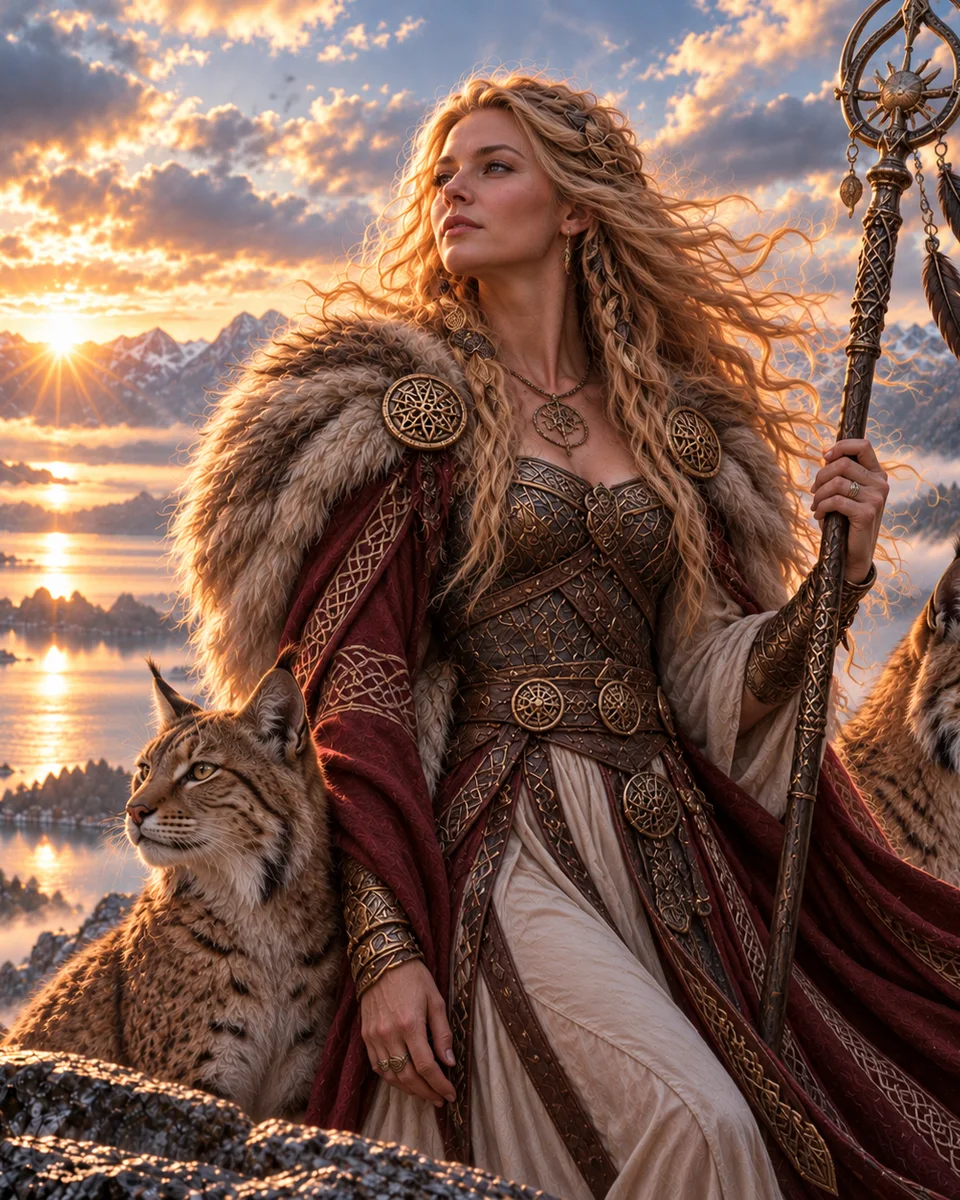
She was more beautiful than the first dawn of spring, more powerful than many warriors, and feared by those who mistook love for weakness. Her name was Freyja – goddess of love, fertility, magic, and war. She could set hearts ablaze with desire, command mysterious sorcery, and claim the bravest warriors who had fallen in battle. Yet behind her beauty lived a soul that refused to be possessed. Freyja was not a goddess who waited for someone else to decide her fate. She intended to write her own story.
The Goddess No One Could Tame
Imagine a morning in Asgard. The first rays of sunlight fall upon golden rooftops and magnificent halls. Emerging from the mist comes a chariot pulled by two enormous cats. Inside sits a woman whose very presence makes even the mightiest gods turn their heads.
Her hair shines like gold in the sunlight, the legendary necklace Brísingamen glitters around her neck, and in her eyes there is both warmth and something far more dangerous.
This is Freyja.
She belonged to the Vanir, a divine family associated with fertility, prosperity, and magical powers. Together with her father Njord and her brother Freyr, she had joined the Æsir following the war between the two families of gods.
But Freyja was never meant to live in someone else's shadow.
She was proud, independent, and passionately alive. She loved beauty, precious treasures, and everything that made the heart beat faster. At the same time, she possessed a power that few dared challenge.
She could be as gentle as a spring breeze and as relentless as a winter storm.
That was her greatest secret: she never had to choose between being loving and being powerful.
She was both.
The Necklace That Stirred the Envy of Gods
Deep within the world of the dwarves, a magnificent piece of jewelry was forged, unlike anything ever seen before.
It was called Brísingamen.
When Freyja laid eyes upon it, she knew it was extraordinary. The gold seemed to radiate a light of its own, and every detail revealed craftsmanship that only the greatest dwarven masters could achieve.
She decided it would be hers.
According to a later Norse tale, the dwarves demanded an unusual price: she would have to spend one night with each of the four craftsmen.
Freyja agreed.
This is one of the most debated stories about the goddess, but it shows how certain traditions portray her as a figure who follows her own desires, even when her choices provoke the anger of other gods.
For Freyja was never created to live according to someone else's expectations.
When she wore Brísingamen around her neck, the necklace became a symbol of her beauty, desire, and unbreakable independence.
But her most valuable possession was not made of gold.
It was her freedom.
The Tears That Turned to Gold
Despite all her power, Freyja could not protect her own heart from sorrow.
She loved her husband, Óðr, but he often departed on long journeys to distant lands. Freyja searched for him, wandering through the worlds under different names.
And when the longing became unbearable, she wept.
But her tears were unlike any others.
When they fell upon the earth, they became red gold. When they fell into the sea, tradition also associates them with amber.
It is one of the most beautiful images in the legends of Freyja.
A goddess who could inspire others to fall in love could herself experience a love so powerful that it caused her pain.
She was not ashamed of her longing.
She did not hide her sorrow.
And perhaps this was precisely what made her so powerful. She understood that love was not merely about happiness and passion, but also about longing, loss, and the courage to continue loving.
Every golden tear became proof that even the hearts of gods could break.
The Magic Even Odin Wanted to Learn
Freyja was a master of seiðr, an ancient form of Norse magic.
Through this mysterious practice, its users could seek knowledge of the future and attempt to influence the course of events.
Freyja was exceptionally skilled.
Norse tradition tells us that she introduced this magical art to the Æsir, and one Icelandic saga describes Odin himself learning it from her.
Consider that for a moment.
Odin, the one-eyed Allfather who had sacrificed so much in his pursuit of wisdom, had something to learn from Freyja.
She possessed knowledge that even the king of the gods did not automatically command.
But her magic was not simply a gift. It could also inspire suspicion and fear. Anyone capable of influencing destiny possessed a power that neither kings nor warriors could fully control.
Freyja knew this.
And she had no intention of allowing the fears of others to limit her abilities.
The Warrior Goddess with a Heart of Fire
Many remember Freyja as the goddess of love and beauty.
But anyone who saw only her beautiful face misunderstood who she truly was.
For Freyja also had a place upon the battlefield.
When warriors fell, she could claim half of those slain in battle. They were taken to her realm, Fólkvangr, where her magnificent hall, Sessrúmnir, stood.
The other half belonged to Odin.
This made Freyja one of the most powerful divine figures associated with death in battle.
She was not merely the goddess who made love blossom.
She was also the goddess who welcomed warriors at their final breath.
Within her existed two extremes of life: the passion that could create new life and the violence of war that could end it.
It was no contradiction.
It was Freyja's nature.
When the Giants Tried to Claim Her
One day, the gods found themselves in a desperate situation.
Thor's mighty hammer, Mjölnir, had been stolen by the giant Thrym. To return it, the giant demanded something that no one in Asgard wanted to surrender.
He wanted Freyja as his bride.
When Thor told her of the demand, Freyja was furious.
So furious that the entire hall of the gods trembled and the mighty Brísingamen fell from her neck.
She would not allow herself to be handed over as payment for a stolen hammer.
Not even to help the gods.
That was when the cunning Loki came up with another solution.
Thor himself would dress as Freyja and travel to the land of the giants disguised as the bride-to-be.
The plan was as ridiculous as it was brilliant.
And it worked.
When the hammer was finally placed in the disguised bride's lap, Thor seized his weapon and reclaimed it by force.
Freyja had refused to sacrifice her freedom.
The gods were forced to solve their problem without treating her as something that could be traded.
Perhaps this reveals more about her personality than any story about her beauty ever could.
The Goddess Who Refused to Be Just One Thing
Freyja was filled with contradictions.
She loved gold, yet her greatest treasure was independence.
She was associated with love, yet could become furious when someone tried to control her.
She wept with longing, yet possessed the power to choose among those who died in battle.
She could teach magic to Odin, even though he was considered the wisest of the gods.
And she was never merely someone's wife, sister, or daughter.
She was Freyja.
Perhaps that is why her stories still speak to us today.
She reminds us that strength does not need to be harsh, that emotions do not make us weak, and that beauty and intelligence need never stand in opposition.
Above all, she shows us that the freedom to choose our own path can be worth more than all the gold in the world.
Freyja's Eternal Secret
No one knows exactly how Freyja's own story ends when Ragnarök comes to the world of the gods. The ancient sources leave her ultimate fate untold.
And perhaps no ending could suit her better.
For Freyja was never a goddess who could easily be contained within a single story.
She was love that refused to surrender, sorrow that turned into gold, magic that challenged authority, and pride that shook the halls of the gods.